PFAS in Children's Clothing: What UK Parents Need to Know
Share
What Are PFAS Chemicals?
PFAS — per- and polyfluoroalkyl substances — are a group of more than 12,000 synthetic chemicals that have been used in manufacturing since the 1940s. You may have seen them called "forever chemicals", and that name is apt: PFAS do not break down in the environment or in the human body. Once they accumulate, they stay.
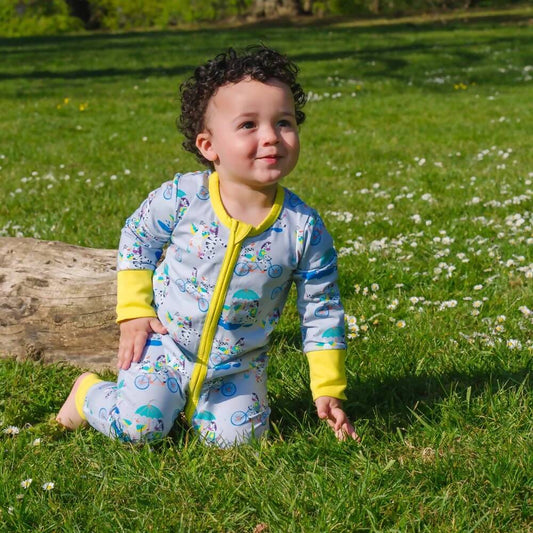
PFAS are found in non-stick cookware, food packaging, firefighting foam, and — perhaps most surprisingly — children's clothing. Waterproof coats, stain-resistant school uniforms, wrinkle-free baby sleepsuits: many of these everyday items are treated with PFAS-based finishes that make them easier to care for and more durable. The problem is the cost to our children's health.
Why Are PFAS Found in Children's Clothing?
Textile manufacturers use PFAS because they are incredibly effective at repelling water, oil, and stains. A raincoat treated with PFAS will bead water beautifully. A school polo shirt treated with stain-resistant chemistry will survive a lunch of baked beans. A baby sleepsuit marketed as "easy care" or "wrinkle free" will come out of the wash looking pristine.
These are genuinely useful properties — but they come at a hidden cost. PFAS are applied to fabric fibres during processing and, over time, they shed. They shed into the wash water. They shed onto your child's skin. They accumulate in dust, in indoor air, and — because PFAS are persistent — in the environment and in our bodies.
Most UK parents buying children's clothing have no way of knowing whether the item they're buying contains PFAS. There is currently no mandatory labelling requirement in the UK or EU that forces brands to disclose PFAS use in textiles.
Why This Matters Especially for Children
Children are not small adults when it comes to chemical exposure. Their immune systems, endocrine systems, and neurological systems are still developing — and developing systems are more vulnerable to chemical disruption than adult ones.
Babies and toddlers are at particular risk. They spend enormous amounts of time in direct contact with fabric — sleeping on it, mouthing it, pressing their faces into it. Their skin is thinner and more permeable than adult skin, meaning chemicals can cross the skin barrier more easily. They also breathe proportionally more air than adults, increasing their exposure to any PFAS that off-gas from clothing or shed into household dust.
Research links PFAS exposure to a range of health concerns including immune system disruption, hormonal interference, reduced vaccine effectiveness in children, thyroid problems, and increased cancer risk over a lifetime of accumulation. The science is evolving rapidly, but the precautionary principle is clear: where possible, minimise children's exposure.
What Can UK Parents Do?
The good news is that safe, beautiful, PFAS-free children's clothing exists — and it is more widely available than ever. Here's what to look for:
- GOTS certification (Global Organic Textile Standard) — the gold standard for organic textiles, GOTS prohibits the use of PFAS and other harmful chemicals throughout the entire supply chain, from cotton field to finished garment.
- OEKO-TEX Standard 100 — tests finished textiles for harmful substances including PFAS, heavy metals, pesticide residues, and formaldehyde. Every component of an OEKO-TEX certified garment has been independently tested.
- Organic cotton — grown without synthetic pesticides or fertilisers, and typically processed without the harsh chemical finishes that conventional cotton goes through. Look for certified organic cotton rather than just "natural" labelling.
- Avoid "easy care", "stain resistant", "water repellent" and "wrinkle free" finishes unless the brand explicitly confirms these are achieved without PFAS.
You can also explore Kiddykind's curated collections specifically chosen for families wanting to reduce chemical exposure: our Plastic Free collection brings together brands committed to plastic-free materials and packaging, our Low Tox collection covers the full spectrum of chemical-free children's products, and our Organic collection focuses on GOTS and organically certified clothing and textiles.
The Kiddykind Curation Promise
Every brand on Kiddykind is vetted before it joins our marketplace. We check certifications, we ask questions about supply chains, and we hold brands to account on the claims they make. We don't list brands that use greenwashing language without the certifications to back it up.
When you buy from Kiddykind, you don't need to cross-reference ingredient lists or decode certification logos — we've done that work for you. Our promise is that every product in our marketplace meets our standards for safety, sustainability, and honesty.
PFAS are one of the less-discussed threats to children's health — but awareness is growing, and parents who know what to look for can make powerful choices. Start with what's closest to your child's skin.